Dropped Spikes vs Added Noise
Both trained networks tolerated substantial spike deletion, but PING accuracy fell more sharply under added spikes. The perturbations changed both recurrent feedback and readout input, so they do not isolate gamma gating.
Abstract
We tested deletion and insertion of transmitted hidden spikes in validation-selected COBA and PING classifiers, using three training seeds and matched MNIST test inputs without retraining. At 80% deletion, mean accuracy was 88.9% for COBA and 89.2% for PING. Insertion at 100% of each network’s unperturbed E rate gave 76.4% and 38.5%, respectively. The interventions changed both recurrent feedback and readout input, so the difference does not isolate gamma timing.
Results
-
Both networks tolerated substantial spike deletion. At 80% deletion, COBA/PING retained 88.9%/89.2% accuracy. At 90%, accuracy fell to 80.1% and 83.6%, respectively. Complete deletion reduced both to 10.6% (Fig. 1A).
-
Added spikes exposed a marked difference in robustness. With addition matched to each network’s baseline excitatory rate, COBA declined gradually while PING fell sharply around 80–110% addition. At 100%, accuracy was 76.4% for COBA versus 38.5% for PING; at 200%, it was 53.1% versus 11.4%. (Fig. 1B).

Figure 1: (A) Random hidden-spike deletion. (B) Independent Bernoulli spike insertion. Lines and markers show means across seeds 42–44, 1000 test images per seed; translucent bands show ±1 sample SD. The PING uncertainty band is grey and is most visible in (B). The dashed line is nominal 10% chance. The insertion axis is the prescribed percentage of each model–seed network’s own unperturbed test-set E rate. Lines average accuracy at matched percentages; nominal Hz can differ across seeds.
- Rasters illustrate how transmitted activity changed. Partial deletion preserved visible PING banding, while addition introduced spikes throughout the intervals between bands (Fig. 2A, B). COBA activity thinned under deletion and became denser under addition (Fig. 2C, D). These single-image examples do not quantify gamma coherence.

Figure 2: Seed-42 trials of the same test image of digit 7. (A) PING deletion; (B) PING addition; (C) COBA deletion; (D) COBA addition. Each deletion panel shows probabilities 0, 0.5 and 1; each addition panel shows nominal rates 0, 100 and 200% of that network’s unperturbed test-set E rate. Insertions were applied independently to E and I. Black marks denote E spikes and red marks I spikes, including inserted events. Each raster samples the same 200 E and 64 I neurons; annotated E rates use the full excitatory population over the displayed trial.
- Total firing concealed suppression of naturally generated spikes. For PING seed 42 at 100% addition, natural E firing fell from 16.6 to 1.7 Hz, while successful insertions contributed 16.6 Hz. This separately measured decomposition is not distinguished in Fig. 2. It supports disruption of recurrent dynamics, but does not establish gamma disruption as the cause of classification failure.
Methods
-
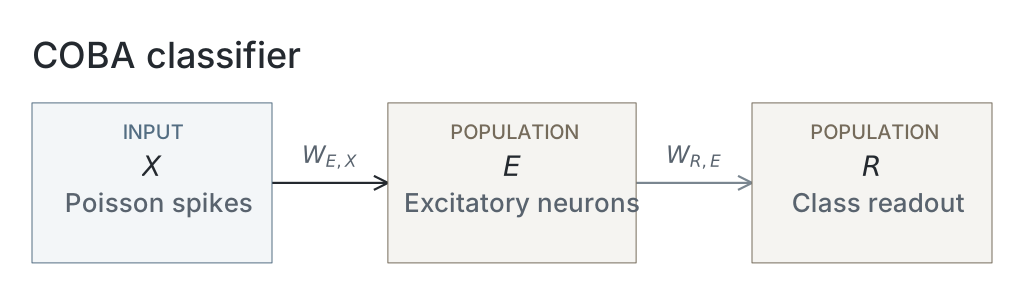
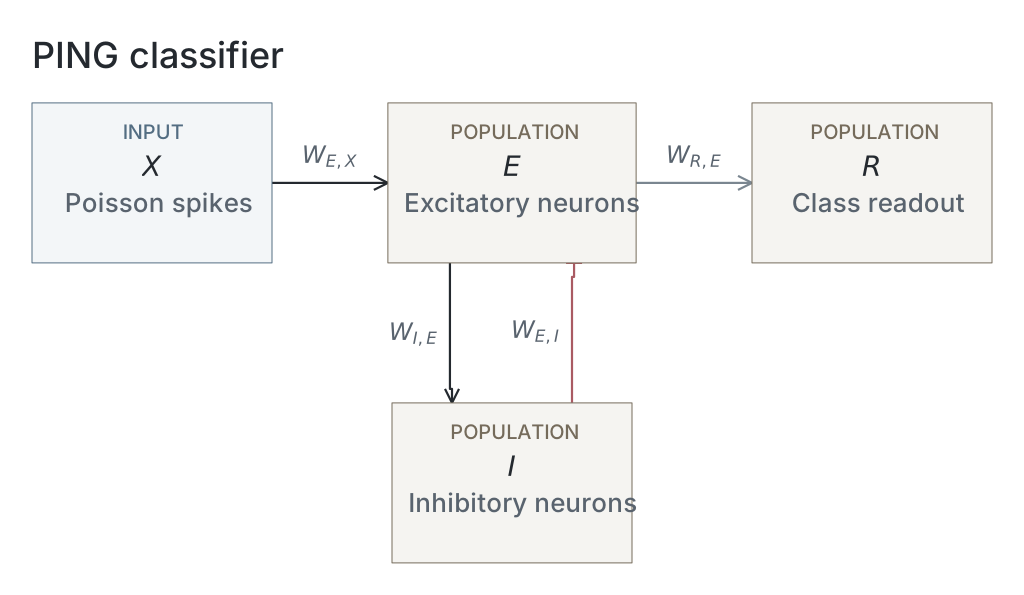
Evaluate trained classifiers. Validation-selected COBA and PING checkpoints from seeds 42–44 were tested on the same 1000 MNIST images without retraining. The reused training pool contained 6,300 optimization and 700 validation images. We selected the minimum-validation-loss epoch from 50 epochs in the unregularized conditions. Networks had 1,024 E and 256 I neurons, with E→I→E coupling enabled for PING and disabled for COBA; recurrent weights were fixed, while input and readout weights were learned. Training voltage-increment gradients were divided by 1,000 for both PING and COBA in the selected replacement bank. The comparison still changes the architecture and learned weights, rather than isolating gamma timing. Trials lasted 200 ms at 0.1 ms resolution, with no warm-up. Pixel intensity set Poisson input rates up to 25 Hz; an independent perturbation generator preserved the input-encoding stream across conditions. Prediction selected the largest time-averaged output membrane potential. The wider activity-penalty comparison is described in exp025 — Inhibition, Accuracy and Firing.
-
Delete spikes after neuronal spike generation. At each timestep, conductances were updated using the preceding timestep’s transmitted spikes. Membrane integration and threshold/reset operations then generated natural spikes. Immediately afterward, before recording or readout input, each emitted E/I spike was independently removed with probability 0–100%, in 10-percentage-point steps. Surviving spikes entered the current readout update and the next timestep’s recurrent feedback. Deletion did not undo the membrane reset associated with a removed spike (Fig. 1A Fig. 2A, C).
-
Insert spikes at the same point in the flow. After membrane integration and natural spike generation, but before recording or readout input, independent Bernoulli events were added to E/I outputs, capped at one spike per neuron per timestep. Collisions with existing spikes added nothing. Inserted spikes entered the current readout update and next timestep’s recurrent feedback, but did not themselves trigger a membrane reset or refractory period. Nominal addition spanned 0–200% of each model–seed’s unperturbed test E rate in 10-percentage-point steps. We calibrated this fixed baseline over the same 1000 test images and multiplied it by the requested percentage divided by 100 to obtain Hz. The same nominal per-neuron rate was applied independently to E and I (Fig. 1B Fig. 2B, D).
-
Separate natural and transmitted activity. We counted natural spikes immediately before modification, successful insertions or deletions during modification, and transmitted spikes afterward. Natural activity therefore refers to neuron-generated spikes within the already perturbed network. Accuracy curves show means ± sample SD across three seeds, not confidence intervals. Illustrative rasters show transmitted activity from 200 E and 64 I neurons for seed 42 and test-image index 0; rate annotations use the full E population. Insertion percentages use the test-set baseline rather than the illustrative image’s rate.
Discussion
Spike deletion did not undo the membrane-voltage reset, and insertion did not trigger a reset or refractory period. These interventions modified transmitted events, affecting both recurrent feedback and readout input. A follow-up could perturb recurrent synaptic inputs while leaving the readout driven by natural E spikes, alongside a readout-only control, to distinguish circuit disruption from direct readout contamination.
Network diagrams
Parameters
Model values are read from original native snapshots through the selected presentation’s compute ancestry. Paired values are E / I. Initializer parent means and SDs describe the original weight distributions, in µS for conductance projections and dimensionless for the current-based readout; they are not measured trained-weight statistics. Missing snapshots or fields are unavailable; current recipes and historical copied tables are not substituted. The recorded configuration identifies the input, numerical and analysis choices of that computation; it does not establish a separate upstream training protocol.
| Parameter | COBA | PING |
|---|---|---|
| Network | ||
| E / I neurons | Unavailable / Unavailable | Unavailable / Unavailable |
| Output neurons | Unavailable | Unavailable |
| Neurons | ||
| Capacitance, E / I (nF) | Unavailable / Unavailable | Unavailable / Unavailable |
| Leak conductance, E / I (µS) | Unavailable / Unavailable | Unavailable / Unavailable |
| Resting voltage, E / I (mV) | Unavailable / Unavailable | Unavailable / Unavailable |
| Threshold, E / I (mV) | Unavailable / Unavailable | Unavailable / Unavailable |
| Reset, E / I (mV) | Unavailable / Unavailable | Unavailable / Unavailable |
| Refractory period, E / I | Unavailable / Unavailable | Unavailable / Unavailable |
| Synapses and weights | ||
| Input→E synapse | Unavailable / Unavailable | Unavailable / Unavailable |
| E→I synapse | Unavailable / Unavailable | Unavailable / Unavailable |
| I→E synapse | Unavailable / Unavailable | Unavailable / Unavailable |
| E→Output synapse | Unavailable / Unavailable | Unavailable / Unavailable |
| Input→E initializer parent mean / SD | Unavailable / Unavailable | Unavailable / Unavailable |
| E→I initializer parent mean / SD | Unavailable / Unavailable | Unavailable / Unavailable |
| I→E initializer parent mean / SD | Unavailable / Unavailable | Unavailable / Unavailable |
| E→Output initializer parent mean / SD | Unavailable / Unavailable | Unavailable / Unavailable |
| Native parameter stage | Unavailable | Unavailable |
| Input and simulation | ||
| Timestep (ms) | Unavailable | Unavailable |
| Duration (ms) | Unavailable | Unavailable |
| Evaluation samples | Unavailable | Unavailable |
| Seeds | Unavailable | Unavailable |
| Input rate (Hz) | Unavailable | Unavailable |
| Post-burn exclusion (ms) | Unavailable | Unavailable |
| Readout and training | ||
| Output neuron model | Unavailable | Unavailable |
| Epochs | Unavailable | Unavailable |
| Checkpoint role | Unavailable | Unavailable |
| Checkpoint purpose | Unavailable | Unavailable |
| Analysis | ||
| Frequency search (Hz) | Unavailable | Unavailable |
| Count-bin width (ms) | Unavailable | Unavailable |
| Autocorrelation maximum lag (ms) | Unavailable | Unavailable |
Dataset
Downstream: exp110 — Manuscript
Current runset
| Run | Date | Duration | Size | Evidence | Storage | Ran on | Verification |
|---|---|---|---|---|---|---|---|
| exp037-r020-present | 20s | 1.6 MB | Current | R2 | HPC | Local: absent; R2: catalog-verified | |
| exp037-r019-analyse | 15s | 392.9 KB | Current | R2 | HPC | Local: absent; R2: catalog-verified | |
| exp037-r018-compute | 46m 34s | 1.5 MB | Current | R2 | HPC | Local: absent; R2: catalog-verified | |
| exp022-r015-compute | 12h 58m 52s | 3.6 GB | Current | R2 | HPC | Local: absent; R2: catalog-verified | |
| exp022-r007-compute | 11h 16m 8s | 3.6 GB | Current | R2 | HPC | Local: absent; R2: catalog-verified | |
| exp022-r001-compute | 2d 7h 4m 16s | 2 GB | Current | R2 | HPC | Local: absent; R2: catalog-verified |