MNIST
Seven controlled training families, their retained checkpoint bank, validation learning curves, and raster diagnostics.
Abstract
We assembled 102 trained spiking networks to recognise handwritten MNIST digits. Seven training groups compare network types, activity limits, timing, connection settings, and input rates. Their saved models and learning histories provide a reusable bank for later experiments.
Training-run overview
The retained bank groups 102 trained models into seven training families, each with initialization seeds 42–44. The table lists each family once; the model count includes all conditions and seeds within it. Dataset sizes refer to distinct images in the pool, followed by the optimizer-training and held-out validation split.
| Training family | Trained models | Image pool (train / validation) | Readout | Input |
|---|---|---|---|---|
| TR01 — Full-data COBA/PING baseline | 6 | 60,000 (54,000 train / 6,000 validation) | Mean pre-reset output voltage | MNIST pixels; Poisson spikes at a fixed 25 Hz peak rate |
| TR02 — COBA/PING activity-ceiling sweep | 36 | 7,000 (6,300 train / 700 validation) | Mean pre-reset output voltage | MNIST pixels; Poisson spikes at a fixed 25 Hz peak rate |
| TR03 — PING inhibitory-decay sweep | 18 | 7,000 (6,300 train / 700 validation) | Mean pre-reset output voltage | MNIST pixels; Poisson spikes at a fixed 25 Hz peak rate |
| TR04 — PING timestep sweep | 15 | 7,000 (6,300 train / 700 validation) | Mean pre-reset output voltage | MNIST pixels; Poisson spikes at a fixed 25 Hz peak rate |
| TR05 — Recurrent initialization/trainability sweep | 12 | 7,000 (6,300 train / 700 validation) | Mean pre-reset output voltage | MNIST pixels; Poisson spikes at a fixed 25 Hz peak rate |
| TR06 — Variable-rate PING | 3 | 7,000 (6,300 train / 700 validation) | Cumulative output spike count | MNIST pixels; Poisson spikes with the peak rate sampled independently per presentation from 11 values spanning 0.5–25 Hz |
| TR07 — PING low-input recruitment sweep | 12 | 7,000 (6,300 train / 700 validation) | Mean pre-reset output voltage | MNIST pixels; Poisson spikes at a fixed 25 Hz peak rate |
All families used the original 28 × 28 MNIST pixel intensities, scaled to [0, 1] and flattened into 784 input channels, without extracted or variable feature sets. “Variable-rate” means changing the Poisson encoding rate of those same pixels. For TR06, the readout sums output spikes over the presentation—the final cumulative spike count, not a cumulative sum of voltages. The official 10,000-image test partition was excluded from training and checkpoint selection. All families trained for 50 epochs; Training-run specification sheets gives the detailed conditions.
Results
The seven figures pair each training family’s learning history with one example of its network activity. Learning curves use validation images; each raster is a separate fixed digit-zero probe of a final-epoch model.
TR01 — Full-data baseline
Best-validation accuracy ranged from 91.51–96.04% across this family’s conditions and seeds. The accompanying raster is one final-checkpoint diagnostic, rather than an estimate of the family mean.

(A) 6 individual validation learning curves across conditions and seeds 42–44. Colours identify the full-data condition; dashed lines are COBA and solid lines are PING. (B) PING baseline, full training pool, 25 Hz peak input rate, seed 42, on one digit-zero presentation. Black marks are excitatory spikes; red marks are inhibitory spikes. Both panels use retained data; no across-seed average or uncertainty band is shown, and the raster is one example rather than a family-wide estimate.
TR02 — Activity limits
Best-validation accuracy ranged from 60.95–91.05% across this family’s conditions and seeds. The accompanying raster is one final-checkpoint diagnostic, rather than an estimate of the family mean.

(A) 36 individual validation learning curves across conditions and seeds 42–44. Colours identify the activity ceilings; dashed lines are COBA and solid lines are PING. (B) PING with a 1 Hz activity ceiling, 25 Hz peak input rate, seed 42, on one digit-zero presentation. Black marks are excitatory spikes; red marks are inhibitory spikes. Both panels use retained data; no across-seed average or uncertainty band is shown, and the raster is one example rather than a family-wide estimate.
TR03 — Inhibitory decay
Best-validation accuracy ranged from 78.05–91.38% across this family’s conditions and seeds. The accompanying raster is one final-checkpoint diagnostic, rather than an estimate of the family mean.

(A) 18 individual validation learning curves across conditions and seeds 42–44. Colours identify the inhibitory decay times. (B) PING with 6 ms inhibitory decay, 25 Hz peak input rate, seed 42, on one digit-zero presentation. Black marks are excitatory spikes; red marks are inhibitory spikes. Both panels use retained data; no across-seed average or uncertainty band is shown, and the raster is one example rather than a family-wide estimate.
TR04 — Timestep
Best-validation accuracy ranged from 88.67–90.33% across this family’s conditions and seeds. The accompanying raster is one final-checkpoint diagnostic, rather than an estimate of the family mean.

(A) 15 individual validation learning curves across conditions and seeds 42–44. Colours identify the simulation timesteps. (B) PING with a 0.1 ms timestep, 25 Hz peak input rate, seed 42, on one digit-zero presentation. Black marks are excitatory spikes; red marks are inhibitory spikes. Both panels use retained data; no across-seed average or uncertainty band is shown, and the raster is one example rather than a family-wide estimate.
TR05 — Recurrent connections
Best-validation accuracy ranged from 89.10–92.24% across this family’s conditions and seeds. The accompanying raster is one final-checkpoint diagnostic, rather than an estimate of the family mean.

(A) 12 individual validation learning curves across conditions and seeds 42–44. Colours identify the recurrent initialization and trainability conditions. (B) PING with fixed recurrent connections, 25 Hz peak input rate, seed 42, on one digit-zero presentation. Black marks are excitatory spikes; red marks are inhibitory spikes. Both panels use retained data; no across-seed average or uncertainty band is shown, and the raster is one example rather than a family-wide estimate.
TR06 — Variable input rate
Best-validation accuracy ranged from 66.67–66.86% across this family’s conditions and seeds. The accompanying raster is one final-checkpoint diagnostic, rather than an estimate of the family mean.

(A) 3 individual validation learning curves across conditions and seeds 42–44. All three curves use the same variable-rate training recipe. (B) variable-rate-trained PING, probed at a 5 Hz peak input rate, seed 42, on one digit-zero presentation. Black marks are excitatory spikes; red marks are inhibitory spikes. Both panels use retained data; no across-seed average or uncertainty band is shown, and the raster is one example rather than a family-wide estimate.
TR07 — Input strength
Best-validation accuracy ranged from 76.43–77.38% across this family’s conditions and seeds. The accompanying raster is one final-checkpoint diagnostic, rather than an estimate of the family mean.

(A) 12 individual validation learning curves across conditions and seeds 42–44. Colours identify the initial input-coupling settings. (B) PING with input-coupling parent mean 0.05 and a 1 Hz activity ceiling, 25 Hz peak input rate, seed 42, on one digit-zero presentation. Black marks are excitatory spikes; red marks are inhibitory spikes. Both panels use retained data; no across-seed average or uncertainty band is shown, and the raster is one example rather than a family-wide estimate.
Methods
The completed bank contains 102 models: 90 reused models with unchanged weights and histories, plus twelve newly trained timestep models. The three existing 0.1-ms timestep models were reused after execution-equivalence checks. We analysed these histories and generated 34 final-epoch seed-42 diagnostic recordings.
-
Prepare the data. Stratified MNIST splits provided 54,000 training and 6,000 validation images for the baseline, and 6,300 and 700 for sweeps. The split seed was 42; the official test set was excluded from training and model selection.
-
Build the networks. Each network contained 1,024 excitatory neurons and ten spiking leaky integrate-and-fire outputs. Recurrent networks added feedback through 256 inhibitory neurons; feedforward controls disabled it. Input and output projections were trained, while recurrent projections were fixed except in designated conditions. Weights retained their excitatory or inhibitory sign. Hidden E/I neurons used 1.2/0.6-ms absolute refractory holds; these were already the effective durations in the reused 0.1-ms executions.
-
Vary the conditions. Seven families covered the baseline, activity ceilings, inhibitory decay, timestep, recurrent initialization and trainability, and input drive. Each condition used initialization seeds 42–44; Training-run specification sheets lists the grids and shared settings.
-
Present the images. Pixels generated Poisson spikes over nominally 200 ms, normally with a maximum-pixel rate of 25 Hz and a 0.1 ms timestep. Variable-rate training sampled uniformly from eleven rates between 0.5 and 25 Hz. Timestep conditions ranged from 0.05 to 0.6 ms; whole-step presentations lasted 199.8 ms at 0.3/0.6 ms and 200 ms otherwise. Firing rates used realised durations.
-
Calculate class scores. Most networks used mean pre-reset output voltage. Variable-rate training used spike counts and smaller initial readout weights.
Each score applies to one output neuron and presentation. Here indexes the timesteps, is dimensionless pre-reset output state, and is a dimensionless binary output spike; both scores are dimensionless.
-
Train the networks. Training used 50 epochs of AdamW, learning rate 0.0004, batches of 256, zero weight decay, and gradient clipping at 1. Surrogate gradients approximated spike derivatives[1]; voltage-gradient damping was 1,000 for recurrent networks and 1 for controls. Activity-constrained conditions minimized
is total loss and is mean cross-entropy. Each presentation’s mean excitatory firing rate and ceiling are in hertz. Brackets average the individual penalties across the minibatch; with rates in hertz, or zero when disabled.
The selected historical bank predates the current recipe’s common voltage-gradient damping of 1,000 for COBA and PING. Its displayed settings and outcomes remain bound to that historical evidence.
-
Select models. Validation averaged three fixed Poisson encoding draws. Selection minimized mean cross-entropy, breaking ties by higher accuracy and then earlier epoch. Selected and final-epoch models were retained.
-
Measure activity and retain models. Accuracy used selected models, whereas firing rates averaged final-epoch validation measurements across images and encoding draws. Retained models and histories support subsequent experiments. Learning curves show individual validation histories; baseline summaries average three seeds. The 34 new seed-42 digit-zero recordings covered every condition, including reused networks; their rasters are individual probes, not across-seed estimates. Spectra used the realised analysis-bin duration: grouping approximately 1 ms of simulation steps gave 0.9-ms bins at the 0.3-ms timestep and 1.2-ms bins at 0.6 ms.
Appendix A — Training-family protocols
The seven training-family descriptions below explain the intended comparisons. The parameter table at the end independently identifies which original model settings can be verified from saved snapshots. The observed learning curves and diagnostic plots are in Results.
Specification: TR01 — Canonical full-data reference
The full-data COBA and PING condition–seed networks are used for headline accuracy. They use the official MNIST training partition with no spike-budget penalty, so the comparison is not affected by the smaller dataset or regularization used in the sweeps. Ten percent of that partition is reserved for checkpoint selection; the official test partition remains untouched during training. This experiment reports their validation learning histories; independent official-test evaluation belongs to the downstream experiments.
Specification: TR02 — Activity-ceiling sweep
This run measures the trade-off between accuracy and firing rate as the activity ceiling is tightened. For each presentation, the loss computes the population-mean hidden-E firing rate, applies a one-sided quadratic penalty above the target, then averages the penalties across the minibatch. Quiet presentations therefore cannot offset active presentations. Expressing the target in hertz and normalising over samples, neurons, duration, and hidden layers makes the intervention comparable across those dimensions. A smaller training pool keeps the multi-seed sweep manageable; only the activity target changes across conditions. Comparisons with the full-data training replicates also change training-pool size and cannot isolate the penalty alone. The resulting checkpoints are used by exp024 — Accuracy Plateaus While Firing Rate Rises, exp025 — Inhibition, Accuracy and Firing, exp037 — Dropped Spikes vs Added Noise, exp038 — Switching On the Inhibitory Loop.
Specification: TR03 — Inhibitory-timescale sweep
This run changes to test how the inhibitory timescale affects gamma frequency, firing rate, and accuracy. All other scientific settings are held fixed, with 6 ms as the standard condition. The resulting checkpoints are used by exp041 — Firing Rate Tracks Gamma Frequency, exp042 — Inhibitory Replay and E Firing, exp046 — One Spike per Gamma Cycle.
Specification: TR04 — Integration-timestep sweep
This run changes the integration timestep while keeping E/I refractory holds at 1.2/0.6 ms. Presentations last nominally 200 ms and contain whole simulation steps. It tests whether the learned operating regime depends on numerical resolution; separately trained networks do not establish fixed-weight numerical convergence. The finest timestep requires the longest unrolled training trajectories. The resulting checkpoints are used by exp044 — Firing Rate Across the Timestep Sweep.
Specification: TR05 — Recurrent-initialization sweep
This run tests whether training preserves the PING loop or learns a useful loop from weaker initial conditions. Recurrent initialization and trainability change together, while the feedforward network and classifier remain fixed to the PING recipe. The resulting checkpoints are used by exp049 — Recurrent Learning Weakens Rhythmicity.
Specification: TR06 — Variable-rate streaming bank
This condition trains PING across the input rates used by the continuous-stream classification study. One rate is sampled uniformly for each presentation, and the ten output LIF neurons produce class logits from their total spike counts rather than their mean membrane voltages. This keeps the cross-entropy logits dimensionless and gives one additional output spike the same logit increment. The readout weights use a small Gaussian initialization, , lower-clamped at zero and governed by the shared non-negative constraint.
The recorded design rationale for this smaller initializer was to avoid saturation at the mean-voltage scale and silence at the generic fan-in-normalized scale. The present bank retains the chosen setting; its learning curves do not independently establish those earlier calibration comparisons. This is a specified spike-count recipe, not a claim that the initializer is uniquely optimal.
Output firing rates may still be reported as activity measurements. During streaming inference, the output neurons reset at digit boundaries while the hidden PING state continues. The resulting checkpoints are used by exp082 — Spike-Count Stream Classification.
Specification: TR07 — Low-input recruitment sweep
TR02 asks how changing the activity ceiling affects networks initialized at the standard input coupling. TR07 asks the complementary question: with the strictest TR02 ceiling fixed at 1 Hz from the first epoch, can PING recruit its inhibitory loop when the feedforward projection starts weak? It varies the parent mean used to initialize expected summed input coupling, before lower clamping and fan-in normalization; it does not directly set the mean of the stored synaptic matrix. The training pool, optimizer, recurrent loop, and mean-voltage readout remain at the reduced-sweep defaults. This bank retains all twelve models, and exp025 — Inhibition, Accuracy and Firing aggregates the three seeds at each setting to test recruitment and path dependence.
Network diagrams
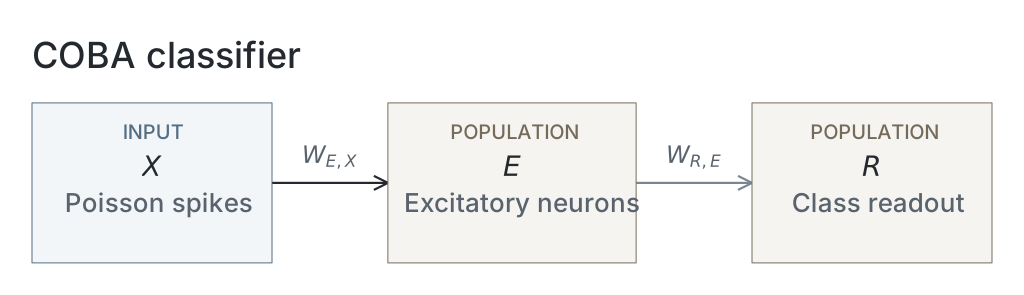
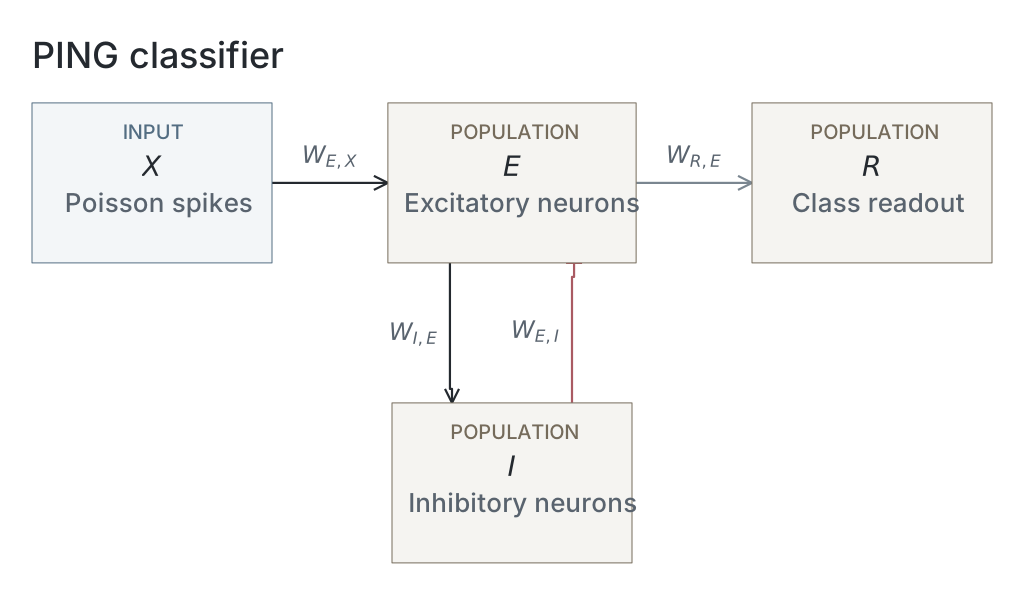
Parameters
Model values are read from original native snapshots through the selected presentation’s compute ancestry. Paired values are E / I. Initializer parent means and SDs describe the original weight distributions, in µS for conductance projections and dimensionless for the current-based readout; they are not measured trained-weight statistics. Missing snapshots or fields are unavailable; current recipes and historical copied tables are not substituted. The recorded configuration identifies the input, numerical and analysis choices of that computation; it does not establish a separate upstream training protocol.
| Parameter | COBA | PING |
|---|---|---|
| Network | ||
| E / I neurons | Unavailable / Unavailable | Unavailable / Unavailable |
| Output neurons | Unavailable | Unavailable |
| Neurons | ||
| Capacitance, E / I (nF) | Unavailable / Unavailable | Unavailable / Unavailable |
| Leak conductance, E / I (µS) | Unavailable / Unavailable | Unavailable / Unavailable |
| Resting voltage, E / I (mV) | Unavailable / Unavailable | Unavailable / Unavailable |
| Threshold, E / I (mV) | Unavailable / Unavailable | Unavailable / Unavailable |
| Reset, E / I (mV) | Unavailable / Unavailable | Unavailable / Unavailable |
| Refractory period, E / I | Unavailable / Unavailable | Unavailable / Unavailable |
| Synapses and weights | ||
| Input→E synapse | Unavailable / Unavailable | Unavailable / Unavailable |
| E→I synapse | Unavailable / Unavailable | Unavailable / Unavailable |
| I→E synapse | Unavailable / Unavailable | Unavailable / Unavailable |
| E→Output synapse | Unavailable / Unavailable | Unavailable / Unavailable |
| Input→E initializer parent mean / SD | Unavailable / Unavailable | Unavailable / Unavailable |
| E→I initializer parent mean / SD | Unavailable / Unavailable | Unavailable / Unavailable |
| I→E initializer parent mean / SD | Unavailable / Unavailable | Unavailable / Unavailable |
| E→Output initializer parent mean / SD | Unavailable / Unavailable | Unavailable / Unavailable |
| Native parameter stage | Unavailable | Unavailable |
| Input and simulation | ||
| Timestep (ms) | Unavailable | Unavailable |
| Duration (ms) | 200 | 200 |
| Evaluation samples | Unavailable | Unavailable |
| Seeds | 3 | 3 |
| Input rate (Hz) | Unavailable | Unavailable |
| Post-burn exclusion (ms) | Unavailable | Unavailable |
| Readout and training | ||
| Output neuron model | Unavailable | Unavailable |
| Epochs | Unavailable | Unavailable |
| Checkpoint role | Unavailable | Unavailable |
| Checkpoint purpose | Unavailable | Unavailable |
| Analysis | ||
| Frequency search (Hz) | Unavailable | Unavailable |
| Count-bin width (ms) | Unavailable | Unavailable |
| Autocorrelation maximum lag (ms) | Unavailable | Unavailable |
Dataset
Upstream: —
Downstream: exp024 — Accuracy Plateaus While Firing Rate Rises, exp025 — Inhibition, Accuracy and Firing, exp037 — Dropped Spikes vs Added Noise, exp038 — Switching On the Inhibitory Loop, exp041 — Firing Rate Tracks Gamma Frequency, exp042 — Inhibitory Replay and E Firing, exp044 — Firing Rate Across the Timestep Sweep, exp046 — One Spike per Gamma Cycle, exp049 — Recurrent Learning Weakens Rhythmicity, exp082 — Spike-Count Stream Classification, exp123 — Decision Time and Gamma Cycles, exp134 — PING: Leak and Capacitance
Current runset
| Run | Date | Duration | Size | Evidence | Storage | Ran on | Verification |
|---|---|---|---|---|---|---|---|
| exp022-r019-present | 1s | 1.3 MB | Current | R2 | Local | Local: absent; R2: catalog-verified | |
| exp022-r016-analyse | 3s | 2.5 MB | Current | R2 | Local | Local: absent; R2: catalog-verified | |
| exp022-r007-compute | 11h 16m 8s | 3.6 GB | Current | R2 | HPC | Local: absent; R2: catalog-verified | |
| exp022-r001-compute | 2d 7h 4m 16s | 2 GB | Current | R2 | HPC | Local: absent; R2: catalog-verified |
Other stored runs (1)
These runs are outside this experiment's current runset. Their evidence status explains why they remain stored.
| Run | Date | Duration | Size | Evidence | Storage | Ran on | Verification |
|---|---|---|---|---|---|---|---|
| exp022-r015-compute | 12h 58m 52s | 3.6 GB | Required by current:exp025, current:exp037, current:exp038, current:exp110, deployment:40549382638/1, report:exp025, report:exp037, report:exp038, report:exp110 | R2 | HPC | Local: absent; R2: catalog-verified |
References
- E. O. Neftci, H. Mostafa, and F. Zenke. “Surrogate Gradient Learning in Spiking Neural Networks: Bringing the Power of Gradient-Based Optimization to Spiking Neural Networks.” IEEE Signal Processing Magazine 36(6), 51–63 (2019). doi:10.1109/MSP.2019.2931595