Inhibitory Replay and E Firing
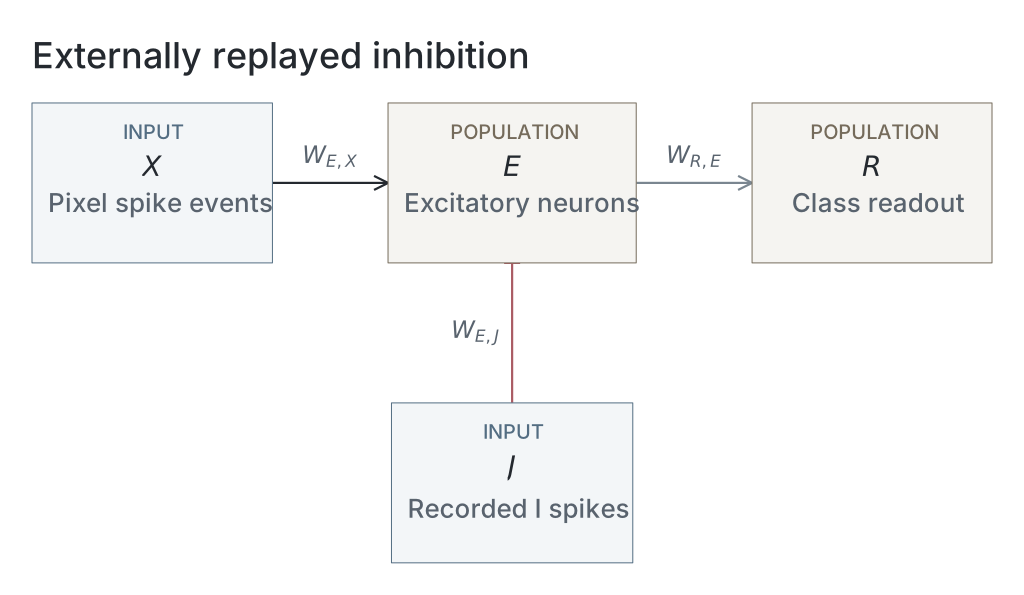
Recorded inhibitory spike streams produced contrasting excitatory responses under independent-spike and fixed-window replay perturbations, but the experiment does not isolate synchrony.
Abstract
We replayed inhibitory spike recordings from three frozen MNIST PING classifiers after either independent-spike jitter or shared shifts within fixed clock windows. At 14 ms jitter, mean E rates were 0.007 Hz under independent shifts and 68.318 Hz under window shifts, with each I neuron’s spike count preserved. Accuracy declined under both interventions. Replay interrupted responsive feedback, so these measurements do not isolate synchrony or a gamma-specific mechanism.
Results
Replay perturbations diverge
At 14 ms jitter, independent shifts reduced mean E firing to 0.007 Hz, whereas fixed-window shifts gave 68.318 Hz. The three reused networks retained their I-spike counts, but replay prevented inhibition from responding to E activity.

Figure 1: (A) Independent-spike and (B) fixed-window group jitter for the illustrative first test presentation from the training replicate initialized with seed 42 at ms; 200 of 1,024 E neurons and 64 of 256 I neurons are displayed over the 200 ms presentation. (C) Independent-spike and (D) fixed-window sweep summaries show per-neuron E rate, realised I-spike rate and test-accuracy means across three training replicates. Retained SEM across training replicates is not displayed.
Methods
-
Models. We reused three independently trained PING networks, initialized with training seeds 42–44.
-
Trials. We tested each network-condition combination on the same 1,000 MNIST test images. The main figure represents 36,000 condition-level trials, or 33,000 distinct simulations because both arms shared the zero-jitter control.
-
Simulation. We presented each image for 200 ms using a 0.1 ms timestep. We encoded pixel intensities as spike trains with a maximum input rate of 25 Hz, fixed across all training replicates and perturbation conditions. Full-intensity pixels therefore had a 25 Hz encoding rate; lower intensities scaled this rate proportionally.
-
Independent jitter. We gave every inhibitory spike an independent Gaussian time shift, using and ms.
-
Group jitter. We divided the timeline into fixed 22.8 ms windows and gave every inhibitory spike within a window the same shift, using and ms. The window spanned 228 simulation steps, obtained by rounding the period of the fixed 43.95 Hz reference to the 0.1 ms grid; windows were not detected gamma cycles.
-
Boundaries. We reflected independent spikes that left the 200 ms interval back into it individually. For group jitter, we reflected the shared displacement once so that the group remained intact.
-
Collisions. We moved same-neuron spikes landing on the same timestep to the nearest unused in-range timestep. No spikes were removed.
-
Measurements. We recorded accuracy and mean excitatory and inhibitory firing rates. Curves show the mean across the three training seeds.
-
Range restriction. We retained larger jitter values as boundary-sensitivity results but excluded them from the main figure because reflection became a substantial part of the intervention.
Network diagrams
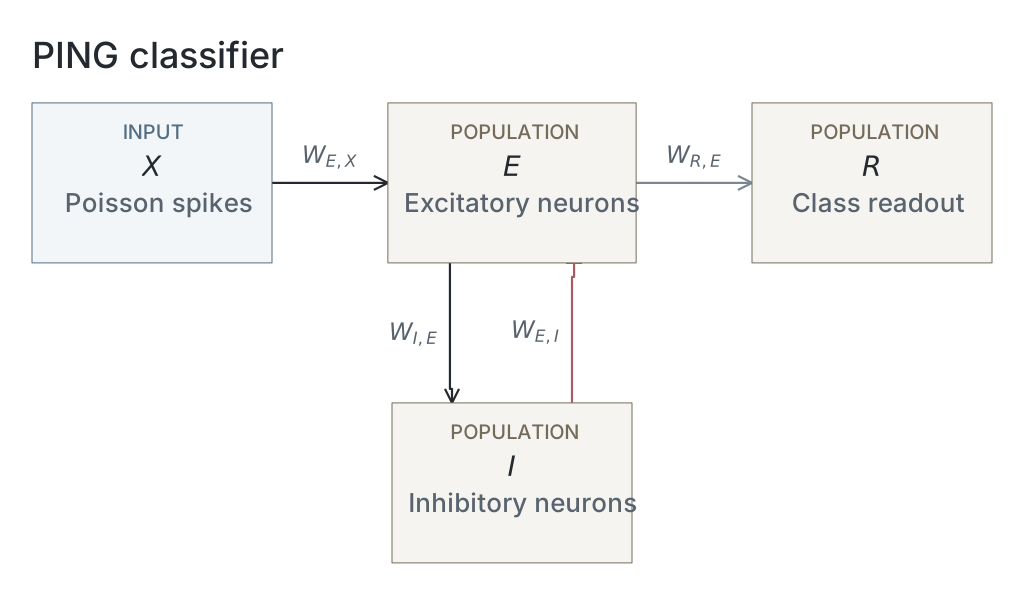
Parameters
Model values are read from original native snapshots through the selected presentation’s compute ancestry. Paired values are E / I. Initializer parent means and SDs describe the original weight distributions, in µS for conductance projections and dimensionless for the current-based readout; they are not measured trained-weight statistics. Missing snapshots or fields are unavailable; current recipes and historical copied tables are not substituted. The recorded configuration identifies the input, numerical and analysis choices of that computation; it does not establish a separate upstream training protocol.
| Parameter | PING |
|---|---|
| Network | |
| E / I neurons | Unavailable / Unavailable |
| Output neurons | Unavailable |
| Neurons | |
| Capacitance, E / I (nF) | Unavailable / Unavailable |
| Leak conductance, E / I (µS) | Unavailable / Unavailable |
| Resting voltage, E / I (mV) | Unavailable / Unavailable |
| Threshold, E / I (mV) | Unavailable / Unavailable |
| Reset, E / I (mV) | Unavailable / Unavailable |
| Refractory period, E / I | Unavailable / Unavailable |
| Synapses and weights | |
| Input→E synapse | Unavailable / Unavailable |
| E→I synapse | Unavailable / Unavailable |
| I→E synapse | Unavailable / Unavailable |
| E→Output synapse | Unavailable / Unavailable |
| Input→E initializer parent mean / SD | Unavailable / Unavailable |
| E→I initializer parent mean / SD | Unavailable / Unavailable |
| I→E initializer parent mean / SD | Unavailable / Unavailable |
| E→Output initializer parent mean / SD | Unavailable / Unavailable |
| Native parameter stage | Unavailable |
| Input and simulation | |
| Timestep (ms) | Unavailable |
| Duration (ms) | Unavailable |
| Evaluation samples | 1000 |
| Seeds | 42 / 43 / 44 |
| Input rate (Hz) | Unavailable |
| Post-burn exclusion (ms) | Unavailable |
| Readout and training | |
| Output neuron model | Unavailable |
| Epochs | Unavailable |
| Checkpoint role | final_epoch |
| Checkpoint purpose | endpoint_dynamics |
| Analysis | |
| Frequency search (Hz) | Unavailable |
| Count-bin width (ms) | Unavailable |
| Autocorrelation maximum lag (ms) | Unavailable |
Dataset
Downstream: exp110 — Manuscript
Current runset
| Run | Date | Duration | Size | Evidence | Storage | Ran on | Verification |
|---|---|---|---|---|---|---|---|
| exp042-r020-present | 1s | 195.2 KB | Current | R2 | Local | Local: absent; R2: catalog-verified | |
| exp042-r019-present | 1s | 192.1 KB | Current | R2 | Local | Local: absent; R2: catalog-verified | |
| exp042-r008-analyse | 4s | 67.5 KB | Current | R2 | HPC | Local: absent; R2: catalog-verified | |
| exp042-r007-compute | 48s | 216.6 KB | Current | R2 | HPC | Local: absent; R2: catalog-verified | |
| exp022-r001-compute | 2d 7h 4m 16s | 2 GB | Current | R2 | HPC | Local: absent; R2: catalog-verified |